
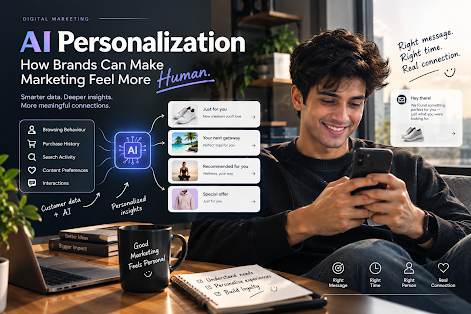
AI Personalization: How Brands Can Make Marketing Feel More Human
Imagine opening your email and seeing a message that recommends exactly what you were looking for. You scroll through Instagram and discover content that matches your interests. Then, you visit an online store and see products that seem almost perfectly suited to you.
This is not simply good marketing. It is AI-powered personalization.
Artificial intelligence is changing the way brands understand and communicate with customers. Instead of sending the same message to everyone, businesses can use AI to analyze customer behavior, preferences, and interactions to deliver more relevant experiences.
However, there is an interesting challenge: How can brands use artificial intelligence without making marketing feel robotic?
The answer is to use AI to improve human connection—not replace it.
What Is AI Personalization?
AI personalization is the use of artificial intelligence and customer data to create marketing experiences tailored to individual users or specific groups.
Traditional marketing often follows a simple approach: create one campaign and show it to a large audience. AI personalization takes a different approach. It can analyze information such as browsing behavior, purchase history, search activity, content preferences, and interactions with a brand.
Based on these signals, AI can help marketers decide:
- What content should a customer see?
- Which products might interest them?
- When should a message be sent?
- Which communication channel is most suitable?
- What type of offer might be relevant?
For example, an online fashion brand might notice that a customer frequently looks at sneakers but rarely purchases formal shoes. Instead of repeatedly showing formalwear advertisements, the brand can personalize recommendations around sneakers, sportswear, or casual fashion.
The goal is simple: show people something useful instead of something random.
Why Does Personalization Matter?
Consumers are exposed to thousands of marketing messages every day. Because of this, generic advertising is becoming easier to ignore.
A personalized message can immediately feel more relevant.
Consider the difference between:
“Check out our latest products!”
and:
“Still looking for everyday sneakers? Here are three new styles you might like.”
The second message feels more personal because it is connected to the customer’s interests.
Personalization can help brands improve customer engagement, increase conversions, encourage repeat purchases, and build stronger relationships.
But there is an important distinction: personalization should feel helpful, not intrusive.
If a brand appears to know too much about a customer, personalization can quickly become uncomfortable.
How AI Can Make Marketing Feel More Human
It may sound strange to say that artificial intelligence can make marketing more human. After all, AI is technology.
But when used correctly, AI can help marketers understand customers better and communicate with them more thoughtfully.
1. Understanding Customer Intent
AI can analyze customer behavior to identify what people may actually want.
For example, someone searching for “best running shoes for beginners” may not simply be interested in shoes. They may be starting a fitness journey.
Instead of immediately pushing a product advertisement, a brand could provide useful content such as:
- Beginner running tips
- How to choose the right shoe
- Common running mistakes
- A beginner-friendly product recommendation
This approach focuses on the customer’s need, not just the sale.
2. Creating Relevant Content
AI can help marketers create different versions of content for different audiences.
A travel company, for example, could communicate differently with:
- A budget traveler
- A family planning a holiday
- A luxury traveler
- A solo backpacker
The brand message remains consistent, but the content becomes more relevant to each audience.
This makes customers feel that the brand understands their situation.
3. Personalizing Recommendations
Recommendation systems are one of the most visible examples of AI personalization.
Streaming platforms recommend movies and shows based on viewing behavior. E-commerce platforms suggest products based on browsing and purchasing activity. Music platforms recommend songs based on listening habits.
When these recommendations are accurate, they save customers time.
Instead of searching through hundreds of options, customers receive a smaller selection that may actually interest them.
That convenience is one of the strongest advantages of personalization.
4. Choosing the Right Time
Personalization is not only about what brands communicate. It is also about when they communicate.
AI can identify patterns in customer behavior and help determine suitable times for sending emails, notifications, or offers.
For example, if a customer regularly interacts with a brand in the evening, sending an important promotional message during that period may be more effective than sending it early in the morning.
The message becomes more relevant because the timing feels natural.
Personalization Without Losing the Human Touch
This is where many brands can make mistakes.
AI can analyze data and generate content quickly, but customers still want authenticity.
If every email sounds identical, every social media post feels AI-generated, and every interaction is automated, customers may feel like they are communicating with a machine.
Brands should therefore use AI behind the scenes while keeping the customer experience human.
For example, AI can help a marketer identify customer interests. But the marketer can then use that insight to create a warm, natural message.
AI might suggest:
“Customer interested in running shoes.”
A human marketer can turn that information into:
“Starting your running journey? We’ve picked a few comfortable options that are great for beginners.”
The technology provides the insight. The human provides the personality.
The Importance of Trust and Privacy
Personalization depends heavily on data, which makes privacy extremely important.
Customers should understand how their information is being used. Brands should avoid collecting unnecessary data and should be transparent about personalization practices.
There is a major difference between:
“We recommend this because you recently viewed similar products.”
and:
“We know exactly what you were doing online.”
The first feels helpful. The second can feel invasive.
Successful AI personalization therefore requires a balance between relevance and respect.
Brands should ask themselves:
“Does this personalization help the customer, or does it simply help us sell more?”
If the answer is only the second one, the strategy needs reconsideration.
Real-World Applications
AI personalization is already influencing many areas of digital marketing.
E-commerce: Personalized product recommendations, offers, and shopping experiences.
Email marketing: Customized subject lines, content, product suggestions, and sending times.
Social media: Personalized content feeds and targeted advertising.
Streaming: Recommendations based on viewing or listening behavior.
Customer service: AI assistants that use conversation history to provide more relevant support.
Advertising: Dynamic advertisements that adapt to different audiences and interests.
These examples show that personalization is becoming less of a luxury and more of an expectation.
The Future of Human-Centered AI Marketing
The future of marketing will probably not be about choosing between AI and humans.
Instead, the strongest brands will combine both.
AI is excellent at processing huge amounts of information, recognizing patterns, automating repetitive tasks, and making predictions. Humans are better at empathy, creativity, storytelling, judgment, and emotional understanding.
The winning combination is therefore:
AI for intelligence + humans for empathy.
A brand should not use AI simply because it is the latest technology. It should use AI when it improves the customer experience.
Conclusion
AI personalization has the potential to completely transform digital marketing. It allows brands to move away from generic messages and create experiences that are more relevant to individual customers.
But personalization is not about showing customers that a brand knows everything about them.
It is about showing them that the brand understands what matters to them.
The most successful marketers will use AI to understand customer needs while using human creativity and empathy to communicate those insights.
In the end, customers do not want to feel like data points.
They want to feel seen, understood, and valued.
And that is where AI personalization can become truly human.